


Knight Survivor
MOBIBRAIN TECHNOLOGY PTE. LTD.
I approached Knight Survivor as a quick-play casual game rather than as a deep role-playing adventure. Its central idea is easy to understand: a knight is pulled into a dangerous situation involving a princess and a dragon, and the player has to respond to that pressure through short, accessible sessions. That makes it immediately appealing when I want something more active than a puzzle but less demanding than a large strategy game.
The important question is not whether it has a dramatic premise. Many mobile games do. The better question is whether its simple hero-versus-danger setup gives you enough moment-to-moment interest to keep opening it after the first session. In my experience, the answer depends heavily on what you expect from a casual game. If you want an easy entry point, a recognizable fantasy theme, and a free download, it has a sensible place on an Android device. If you are looking for a carefully plotted adventure or a long-form action game with extensive control, I would set expectations lower.
How I judge the game before recommending it
I look at four things first: how quickly a new player understands the objective, whether a short session feels worthwhile, how much friction appears between attempts, and whether spending money feels optional rather than necessary. Those criteria matter more here than a large feature checklist. A casual game succeeds when it respects small pockets of time and gives the player a reason to try one more round without making the whole experience feel like work.
The fantasy framing helps with that first impression. The store summary presents a call for a hero, a princess in danger, and a dragon creating the threat. I do not need a long explanation to understand the mood. The store short description identifies it as a knight-survival game, so I went in expecting pressure, repetition, and a focus on staying alive rather than a traditional chapter-based role-playing campaign.
That distinction is useful when comparing it with nearby alternatives. A match-three game is usually built around deliberate board decisions. An idle game asks you to check progress periodically. A conventional endless runner emphasizes timing and lane movement. Knight Survivor sits closer to the action-survival side of casual gaming, where the appeal comes from handling danger in compact bursts. It is a better fit for players who want a little tension than for someone seeking a quiet, methodical pastime.
Related News






I also consider whether the game can fit ordinary routines. A realistic use case is a short wait before an appointment: I can open it, play without committing to a long story sequence, and put the phone away when my name is called. It also suits a few minutes after dinner when I want interaction but do not want to learn a complicated control scheme. That convenience is one of its strongest practical qualities.
The first sessions and the learning curve
The opening experience is approachable because the theme communicates the stakes immediately. You are not asked to understand a large fictional world before enjoying the basic premise. I found that helpful on a phone, where the best casual games usually explain themselves through play instead of forcing the player through a long introduction.
My advice is to treat the first few sessions as observation rather than as a test of skill. Watch how danger develops, notice which decisions create breathing room, and avoid spending anything simply because an early obstacle appears. In games built around survival pressure, a player can mistake unfamiliarity for a need to buy progress. Taking a little time to understand the rhythm is the cheaper and more useful first step.
Gallery
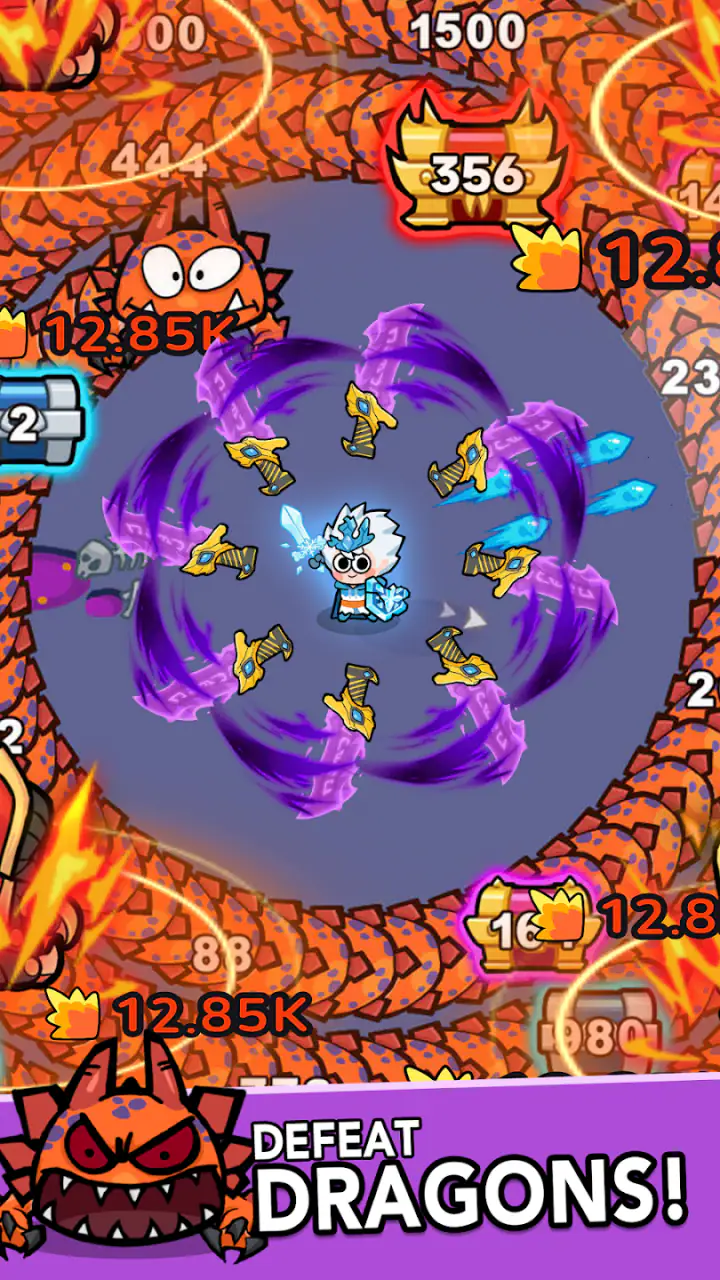
One practical habit is to begin each attempt with a clear purpose. If I am learning, I pay attention to enemy pressure and movement. If I am trying to improve, I focus on surviving longer and avoiding unnecessary risks. Separating those goals prevents a disappointing run from feeling meaningless. Even when an attempt ends quickly, it can reveal which situations deserve a different response next time.
The knight-and-dragon setup also gives the game a stronger identity than an unnamed survival challenge. That does not automatically make the mechanics deeper, but it makes the action easier to enter emotionally. I am more willing to return to a scenario when I understand who I am protecting and why the danger matters, even if the actual play remains straightforward.
What makes the short-session format work
The strongest part of the design, from my perspective, is its suitability for repeated attempts. I do not need to reserve a large block of time or remember a complicated plot after a busy day. The game’s casual classification is appropriate because the barrier to entry is low, while the survival framing provides more urgency than a purely passive or decorative experience.
That balance makes it useful in situations where a conventional console-style game would be inconvenient. I would choose it during a commute break, while waiting for food, or when I want a quick distraction without starting a long campaign. The key is to see each session as a self-contained challenge. Expecting every attempt to deliver a major story development would make the experience feel thinner than it is meant to be.
Another useful approach is to stop while the game still feels fresh. Casual survival games can become repetitive when played beyond the point of concentration. I get better value by using it in small portions instead of turning it into an all-evening commitment. That is not a weakness unique to this title, but it is especially relevant here because the central fantasy scenario can lose impact if repeated without breaks.
The game is also a reasonable option for someone who wants fantasy flavor without the homework associated with a large role-playing game. There is no need to learn a huge cast or memorize a complex history before engaging with the knight’s situation. For a player who likes dragons and heroic rescue stories but prefers compact mobile sessions, that focus is welcome.
Where Knight Survivor wins against nearby casual choices
Knight Survivor has a clear advantage over slower casual categories when I want immediate pressure. A puzzle game may give me more time to think, and an idle title may require less attention, but neither necessarily creates the same feeling of reacting to danger. Here, the fantasy conflict gives a short session a recognizable purpose, which helps the game feel more active than a background progression app.
It can also be a better choice than a story-heavy mobile role-playing game for a player with limited patience. Large RPGs often ask for downloads, tutorials, dialogue, menus, and long-term planning before the main loop becomes comfortable. This game presents a much narrower promise: take the role of a knight and deal with survival pressure. That simplicity is valuable when I want to play now rather than prepare to play later.
Compared with a typical endless runner, the appeal is less about memorizing a route and more about managing a threatening situation. I would choose a runner when I want pure reflex and constant forward motion. I would choose this game when the fantasy setting and survival framing matter more to me than speed alone. Neither category is universally superior; they satisfy different moods.
A less obvious strength is that its theme can make repetition feel more purposeful for casual players who normally abandon abstract arcade games. The princess and dragon provide a small narrative hook without requiring the game to become a full adventure. That can be enough to encourage another attempt, especially for someone who enjoys heroic scenarios but does not want a complicated story interface.
The game is free to download, which lowers the cost of trying it. Its current version is 1.4.4, and it supports Android 7.0 or later, so it is accessible to people using a broad range of Android devices. I still recommend checking the phone’s available storage and performance in practice, because compatibility on paper does not guarantee that every handset will feel equally comfortable during active play.
Its audience size also suggests that it is not an obscure experiment: the game has passed 500 thousand installs, with an average rating of 4.0 from around 9.5 thousand ratings. I read that as a sign of a reasonably established casual release, not as proof that every player will enjoy it. Ratings are most useful here as a confidence signal that enough people have tried the basic concept to make downloading it a rational low-cost experiment.
Where another category may fit you better
I would not recommend this game to someone whose main priority is a rich, branching narrative. The premise gives the action a reason to exist, but a survival-focused casual title should not be mistaken for a novel-length fantasy journey. If your ideal mobile experience is dialogue, exploration, character relationships, and carefully paced discovery, a story-driven role-playing game will probably serve you better.
It may also be the wrong choice for players who dislike repetition. Survival formats naturally ask you to revisit a similar challenge and improve through familiarity. If you prefer a fixed sequence with a clear ending, a traditional level-based platformer or puzzle campaign may feel more satisfying. The knight theme will not remove the repeated nature of the core activity.
Players who want deep control over every action should compare it with a more technical action game before committing. The casual positioning is a benefit for accessibility, but it can also feel limiting to people who enjoy complex builds, precise manual combat, or extensive customization. I would not switch from a serious action RPG expecting the same level of mastery.
There is another audience that may want to skip it: anyone who finds in-app purchases distracting. The game is free, but individual purchases range from $0.49 to $99.99. That is a very wide spending range, and it makes it important to decide in advance how you want to play. I would begin with a no-spend trial, use the game’s ordinary progression, and only consider a purchase if I already know the game deserves continued attention.
That approach protects the main advantage of a free casual download. You can test the controls, repetition, and overall mood without making the decision feel financially serious. If the game does not hold your interest after several short sessions, uninstalling costs nothing. If it does become a regular pastime, you can then judge whether optional spending adds genuine convenience rather than buying out of frustration.
Small habits that improve the experience
My first tip is to avoid playing on autopilot. Survival games often punish attention that drifts, especially when a player becomes comfortable with the opening moments. I try to use the quieter part of an attempt to prepare for the next threat instead of treating it as free time. That makes later failures more informative and reduces the feeling that the result was random.
My second tip is to separate entertainment from progression. If I open the game only to chase a particular improvement, a weak attempt can feel like wasted time. If I open it to enjoy a short fantasy action session, progress becomes a bonus. This mindset is especially useful for casual players who do not want the game to compete with their schedule.
Third, I would use the age guidance seriously. The game is rated Everyone 10+, so it is aimed at a broad audience but not necessarily at very young children. The dragon-and-danger premise is accessible, yet parents should still decide whether fantasy conflict suits the child using the device. I would also keep purchase controls protected on a shared phone, since the game includes paid items.
Finally, I would not judge the game solely by the first attempt. The opening can feel simple because the player is still learning the danger pattern and the intended rhythm. Give it a handful of brief sessions, but do not force yourself through hours if the core loop already feels repetitive. That is the fairest test: enough time to understand the design, not so much time that sunk-cost thinking takes over.
What switching to it really involves
Moving from another casual game is easy in one sense: the download is free, the fantasy premise is clear, and the game does not ask you to replace a complex routine. The real cost is attention. You are exchanging the familiar satisfaction of a puzzle board, runner route, or idle timer for repeated survival attempts. Whether that exchange feels worthwhile depends on whether you want active pressure or a calmer rhythm.
If you are coming from an idle game, expect to interact more often. You cannot approach this as something that quietly progresses while you do other tasks. If you are coming from a puzzle game, expect less time to deliberate and more need to respond to unfolding danger. If you are coming from an action game, expect a lighter and more accessible structure rather than a direct substitute for a demanding combat system.
The financial switch is straightforward but deserves discipline. Since the title is free and offers purchases from $0.49 to $99.99 per item, I would not attach a budget to it before understanding how often I actually play. A small purchase can feel harmless, while a large one can change the economics of a supposedly casual hobby. My recommendation is to disable impulsive buying on a shared device and treat every purchase as a separate decision.
There is also a device consideration. The minimum operating system is Android 7.0, which means many Android users can install it, but an older supported phone may not deliver the same comfort as a newer model. I would test it during a normal session rather than relying only on installation eligibility. If controls feel cramped or performance interrupts concentration, the problem may be the device fit rather than the game’s central idea.
The developer is MOBIBRAIN TECHNOLOGY PTE. LTD., and the release is recent enough that I would keep an eye on how the experience develops through future versions rather than assuming the current balance is permanent. The version I reviewed is 1.4.4. For a player deciding today, that means the sensible approach is to evaluate the present game on its own merits while remaining aware that mobile titles can change over time.
Switching is therefore inexpensive in money but not necessarily free in habit. The game competes for the same small moments as every other casual app. It earns a place when its knight-survival loop gives you a more satisfying use of those moments than your current favorite. It does not earn that place simply because the premise sounds dramatic.
Who should install it first
I would start with players who enjoy fantasy themes, short action sessions, and the modest satisfaction of improving after a failed attempt. It is particularly suitable for someone who wants a free game that can be sampled without committing to a large campaign. The broad age guidance also makes it more approachable than many darker or more complicated fantasy releases, although individual family preferences still matter.
I would be more cautious with competitive players who need precise rankings, elaborate builds, or a large social layer to stay interested. Those expectations can make a compact casual survival title feel underdeveloped. The same applies to players who want a game that can be played almost entirely passively. The knight’s situation is meant to hold your attention, not merely fill a progress bar in the background.
For a household tablet, it can be a convenient shared option because the premise is easy to explain and the price of entry is zero. I would still supervise purchases and decide whether the age guidance fits the intended player. For an adult phone, it works best as a deliberate short break rather than as a replacement for a larger game library.
My recommendation after weighing the trade-offs
I recommend trying Knight Survivor if you want a casual fantasy game built around compact survival sessions and you are comfortable with repetition. Its strongest qualities are its clear heroic premise, accessible entry point, and ability to fit into ordinary waiting time. The free download makes that recommendation easy: you can discover whether the action suits you without paying first.
My recommendation becomes qualified if you are sensitive to in-app purchases. The available price range means I would play with a firm spending limit and avoid treating purchases as a solution to early frustration. The game is more appealing when the challenge remains something I am learning to handle, not something I feel pressured to buy my way through.
I would choose it over a puzzle game when I want urgency, over an idle game when I want direct involvement, and over a large RPG when I want to start playing immediately. I would choose those alternatives instead when I want calm planning, passive progress, or a substantial story. That is the clearest way to understand its place: it is a focused casual action option, not a universal replacement for every mobile genre.
The rating of 4.0 and the established install base give me enough confidence to suggest a trial, while the current version and Android 7.0 requirement make it practical for many users. Still, neither popularity nor compatibility answers the personal question of repetition. Spend a few short sessions testing whether the dragon-driven danger keeps your attention. If it does, this knight has earned a place in your casual rotation. If it does not, moving to a puzzle, runner, idle game, or story-focused alternative will be a better use of your time.
FAQs for Knight Survivor
What is Knight Survivor about?
Knight Survivor is an action-survival game in which you control a brave knight fighting against continuous waves of enemies. The main objective is to stay alive, collect experience and rewards, improve your abilities, and become stronger during each run. Its simple controls make it easy to start, while enemy variety, upgrades, and increasingly difficult encounters provide a greater challenge over time.
How does the gameplay work in Knight Survivor?
The game generally combines movement, automatic or easy-to-use attacks, and survival-focused progression. You guide the knight around the battlefield, avoid enemy attacks, gather useful items, and choose upgrades as your character develops. Each session can feel different depending on the abilities and equipment selected, so experimenting with combinations is important when facing stronger enemies and difficult stages.
Can Knight Survivor be played offline?
Knight Survivor may support offline play for its main action and survival stages, which is convenient when you do not have a stable internet connection. However, certain features can require online access, including advertisements, cloud-related services, updates, special events, or purchases. It is recommended to open the game while connected at least once and check the requirements shown on your device.
Is Knight Survivor free to download and play?
Knight Survivor can usually be downloaded without an upfront charge, but free access may include optional in-app purchases and advertising. These extras can provide resources, bonuses, cosmetic content, or other conveniences, depending on the version available in your region. You should review the store listing and purchase settings before downloading, especially if the game will be used by children.
Is Knight Survivor suitable for beginners and younger players?
Knight Survivor is relatively accessible for beginners because its core objective is straightforward and the controls are not difficult to understand. Nevertheless, later stages may become demanding and require quick movement, careful upgrade choices, and repeated attempts. Parents should also check the age rating, advertising content, privacy information, and in-app purchase options before allowing younger players to install it.
Pros
- Simple controls make it easy to start playing immediately.
- Short runs fit well into quick gaming sessions.
- Upgrade choices add variety to each survival attempt.
- Fantasy visuals give the game a clear and appealing identity.
- Offline play is convenient when an internet connection is unavailable.
Cons
- Later stages can feel repetitive once enemy patterns become familiar.
- Random upgrade options may make some runs feel unfair.
- Progress may depend heavily on grinding between attempts.
- Small-screen combat can become crowded during intense waves.
- Ads or optional purchases may interrupt the otherwise quick gameplay.


